

How To Write the Perfect Travel Nurse Resume
A well-crafted travel nurse resume is key for landing your dream travel nursing job, but probably not in the way you imagine. Forget the image of a hiring manager sifting through a pile of resumes – that’s not quite how it works in the travel nursing world. Understanding how the hiring process, traveler profiles, and the Applicant Tracking System (ATS) work can help you design a travel nurse resume that gets noticed.
Why Your Travel Nurse Resumes Matters
Initially, you’ll submit your resume to your recruiter, who will then contact your references, and use your resume to create a traveler profile.
A traveler profile is a streamlined document containing the essential information needed to present you for travel nursing roles.
You might be thinking, “Why bother with my resume if the traveler profile is what hospitals see?” Well, hiring managers often want to peek at your original resume too. A solid travel nurse resume also ensures that all your skills, experiences, and certifications are accurately highlighted on your traveler profile.
Most agencies and hospitals utilize the Applicant Tracking Systems (ATS) to screen candidates. The ATS combines your resume and traveler profile into a submission for the hiring hospital. So, if your resume isn’t up to par, it can get automatically disregarded by the ATS. This underscores the importance of crafting a resume that is ATS-friendly, ensuring that that your resume is easily readable by the system.
Though the process might seem impersonal, you can leverage the system to your advantage by designing your resume to meet ATS requirements and including key qualifications for the job you’re targeting.
How to Format an ATS-Friendly Travel Nurse Resume
Although creating fun, visually appealing resumes is enticing, it’s best to keep it simple. Follow the tips below to create a professional resume that the ATS will like:
- Avoid graphics, photos, colours, or funky fonts.
- Use Times New Roman or Arial only (boring, I know).
- Follow these font size guidelines:
- Main headers: 18-20pt
- Section headers: 14-16pt
- Body content: 10-12pt (no smaller than 10pt)
- Don’t worry too much about resume length; given the nature of temporary contracts, travel nurse resumes are expected to be longer. Focus on keeping it well-structured and concise, ideally two pages or less.
Have an organized, easy-to-read layout including the following information in this order:
Personal Information
Your full name, physical address, email address, and phone number. You can also include your availability to take phone interviews if you wish. Just remember to anticipate and answer the call. A missed call could mean a missed opportunity! Prepare for your interview by learning what to expect and how to nail your travel nurse interview.
Professional Summary
Highlight why you’re a perfect candidate for the job and a rockstar nurse! Use a short and sweet version of your elevator pitch – ideally in bullet point form. Include job listing keywords and traits that managers look for in travel nurses, such as adaptability, flexibility, communication skills, and teamwork.
Travel Nurse Work Experience Section
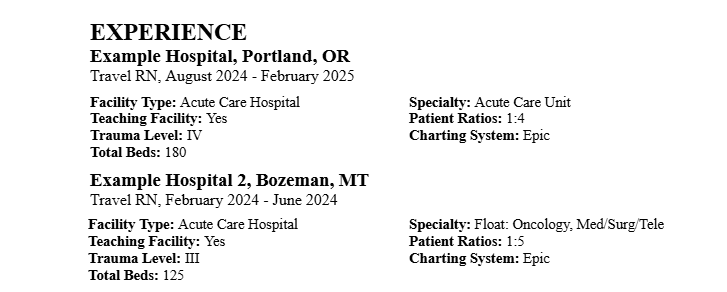
List your employment history chronologically, with your most recent contract at the top. Include the following information about each facility you’ve worked at:
- Facility Name, City, State
- Job Title (staff RN, travel RN, charge RN)
- Dates of Employment
- Facility Type (acute care hospital, outpatient clinic, SNF, etc)
- Number of Total Beds
- Teaching Facility (Y/N)
- Trauma Level
- Unit Type/Specialty (Med/Surg, ICU, L&D, etc)
- Patient Ratio (1:4, 1:5)
- Charting System (EPIC, Cerner, etc)
If you can’t remember all the details of each facility, head to American Hospital Association Hospital Lookup to find your answers!
Here’s an example of how this section should look:
Licenses and Certifications Section
List all of your active state RN licenses, including license number and expiry date. Be sure to distinguish if you have a compact license. You can find this information on Nursys.com.
Include any certifications you may have in this section. This would include BLS, ACLS, NIHSS, FEMA, ONC, CCNS, etc. Be sure to add the expiration date or course completion date. It’s also important to state the organization where you obtained the certification. For example:

Education Section
State the educational institution where you received your nursing education in this format: Name of College, City, State/Province, Country. In the line below, write “Bachelor of Science in Nursing” or whatever degree applies to you. Finally, add the dates you attended.
If you have more post-secondary education, be sure to include that too!
Skills Section
List your charting system experience (EPIC, Cerner, etc), any specialized equipment you’re educated in using, second languages you may speak, and any other bonus skills!
Achievements
Daisy awards, Shining Star awards, preceptor or mentorship roles, etc.
References
At the bottom of your travel nurse resume, include four to five references with whom you’ve worked with in the past year. References can be nurse managers, charge nurses, and resource nurses. Include their name, role, email, and phone number.
Remember, it is unlikely for a hiring facility to reach out to your references directly. Your recruiter will be the one to contact them, usually by email.
Get in the habit of collecting references at the end of every contract so you always have an up-to-date list of colleagues who will speak highly of you.

Travel Nurse Resume Tips (If You Have No Travel Experience Yet)
Even before you have any travel nurse contracts under your belt, your resume can still shine and showcase your potential as a travel nurse. The key here is to highlight the desired qualities of a travel nurse, such as:
- Adaptability
- Communication skills
- Critical thinking
- Cultural Sensitivity
- Time Management
- Reliability
- Professionalism
Just because you haven’t worked as a travel nurse yet doesn’t diminish the value of your staff job experience, education, certification, and achievements. Prove that you are a qualified professional and are eager to broaden your nursing career through travel nursing. This can be shown on your resume, but even more so during your travel nurse interview.
Remember, all travel nurses started somewhere and got their first contract without any prior travel experience!
Travel Nurse Resume Checklist
Before submitting your resume, make sure it includes:
✔ ATS-friendly formatting
✔ Clear and detailed work history
✔ Licenses and certifications
✔ Relevant skills and charting experience
✔ Strong references
✔ Keywords from the job description
Frequently Asked Questions About Travel Nurse Resumes
How long should a travel nurse resume be?
Travel nurse resumes are often slightly longer than traditional resumes because nurses may have multiple short-term contracts to list. Most travel nurse resumes fall between one and two pages, though length is less important than clarity and completeness.
What should be included on a travel nurse resume?
A strong travel nurse resume should be include your contact information, professional summary, work experience, education, licences, certifications, education, and relevant skills. It is recommended to include charting systems, patient ratios, and facility details to give hospitals a better understanding of your experience.
Can you become a travel nurse with no travel experience?
Yes, many travel nurses land their first contract without prior travel experience. If you are transitioning from a staff nursing role, focus on highlighting qualities that travel nurses need, such as adaptability, teamwork, strong communication skills, and the ability to learn quickly. Hospitals want nurses who can safely integrate into new environments and handle different workflows with minimal training.

Keep your travel nurse resume simple, professional, and ATS-friendly. Update it regularly as you gain new experiences, certifications, and references. Think of your travel nurse resume as your passport to new opportunities and career experiences!